Several types of algae can grow in swimming pools. The most common types of pool algae are green algae, yellow (or mustard) algae, black or blue-green algae, and pink algae. Here’s a brief description of each type:
Green algae: This is the most common type of algae found in pools. It appears slimy on pool and spa surfaces and can proliferate in 24 hours or less.
Yellow (or mustard) algae: This type of algae has a brownish or muddy yellow colour. While it doesn’t spread as quickly as green algae, it is harder to destroy. Like green algae, yellow algae grows in the same fur or mold-like pattern. Unlike green algae, brushing will not remove it much, although it will remove the top layer of slime, which exposes the algae underneath.
Black or blue-green algae: This type of algae can grow in unmaintained pools. Black algae is difficult to treat as it is highly resistant to chlorine. Unlike green or yellow algae, black algae doesn’t have that outer layer of slime, which acts as a protective barrier for the algae underneath, it has a tough membrane that needs to be addressed to allow treatment to be successful. Black algae will penetrate deeply into hard surfaces, like plaster and concrete. It first appears as black spots and then proliferates.

Treatment
Options for an algal outbreak vary based on several factors, all of which must be considered before initiating treatment. These factors include:
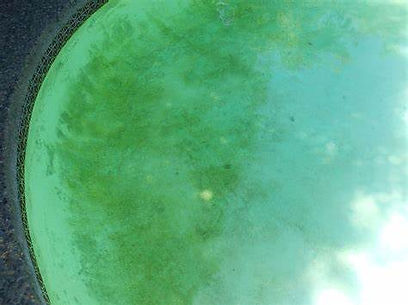
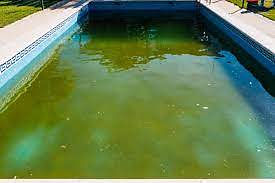
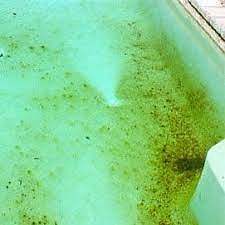
Blue and green algae can be present in various ways below are some examples to assist in identifying the algal outbreak
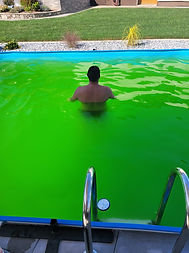
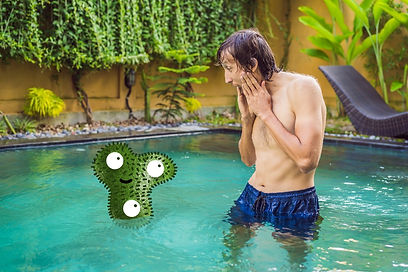
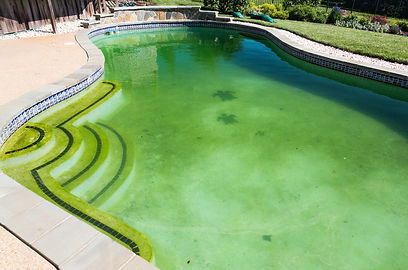
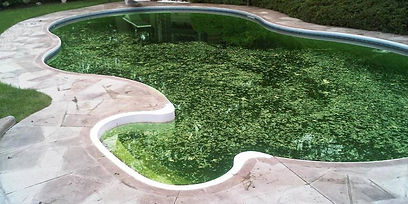
The brief answer is that it varies.
Algae are drawn to bacteria and parasites, which can infiltrate the body via the nose, eyes, ears, mouth, or a small cuts. However, it is known to emit cyanotoxins are highly potent toxins produced by cyanobacteria, commonly known as blue-green algae, which can be harmful to health. In such cases, swimming in green pool water is less safe.
Hence, regular chemical testing is crucial. If the green color is due to pollen, it might be challenging to reduce the discoloration without closing the pool.
However, if there are no pollen allergies, swimming in green pool water is generally safe.
Green algae are the most common and fastest‑growing algae found in swimming pools. It spreads quickly when chlorine is low, circulation is poor, or water balance drifts out of range. It’s also the easiest algae type to remove when treated promptly.
Green algae are free‑floating plant‑like organisms that turn pool water cloudy or bright green. They often form slimy patches on walls and steps and brush off easily into a green cloud.
Green algae thrive when sanitizer levels drop or water becomes unbalanced. Common triggers include:
Low free chlorine — the primary cause; algae spread rapidly when FC falls below target.
High pH or high CYA — both reduce chlorine efficiency.
Warm weather & sunlight — ideal growth conditions, especially in Australian summers.
Poor circulation or filtration — dead spots allow algae to anchor and multiply.
Organic debris — leaves, dust, pollen, and rain introduce nutrients (phosphates).
Technicians look for:
Cloudy or bright green water
Slippery surfaces
Green dust that brushes off in clouds
Rapid spread across the whole pool
These traits distinguish it from mustard algae (yellow dust in shady areas) and black algae (dark, rooted spots).
A light bloom where water is slightly dull/greenish and walls feel a bit slippery, but visibility is still good and algae hasn’t fully taken over the water column.
This is the easiest stage to reverse — fast action prevents a full bloom.
Brush everything (not negotiable)
Set pH to 7.0-7.2 (This step is critical because chlorine is far more effective at lower pH.)
Shock the Pool (Light–Moderate Dose)
Check CYA (Stabiliser) Maintain between 30 to 50ppm
Remove Phosphates 0-0.1 ppm
Filter & Circulate (run cleaned filtration for 24 hours)
Add Algaecide (Only after clearing algaecide is not the first step - it’s a finishing step.)
For full treatment instructions, click MildGreen
A heavy bloom where water is deep green, walls are inundated, and visibility poor to completely opaque and algae has fully taken over the water column.
This is the harder stage to reverse, and pool should be closed for a period of at least 48 hours — aggressive chemical and mechanical intervention is required to return the water column to an acceptable state of health and appearance.
Brush everything (not negotiable)
Set pH to 7.0-7.2 (This step is critical because chlorine is far more effective at lower pH.)
Shock the Pool (Heavy Dose)
Check CYA (Stabiliser) Maintain between 30 to 50ppm
Remove Phosphates 0-0.1 ppm
Filter & Circulate (run cleaned filtration for 24 hours)
Add Algaecide (Only after clearing algaecide is not the first step - it’s a finishing step.)
For full treatment instructions, click Severe Green
Keeping green algae away long‑term requires:
Maintaining FC 2–4 ppm
Keeping pH 7.2–7.6
Ensuring good circulation and adequate pump runtime
Weekly brushing of walls, steps, and dead spots
Regular filter cleaning
Managing phosphates if levels exceed ~300–500 ppb (optional but helpful)
Black spot algae are notoriously difficult to treat due to their resistance to chlorine.
Below are some examples of the algae outbreak.
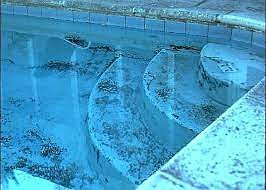
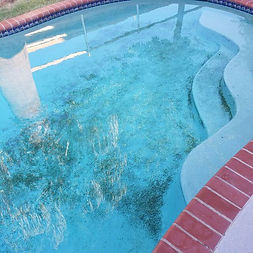
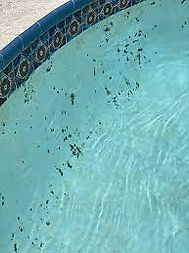
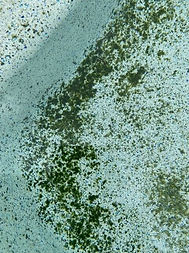
Blackspot algae (more accurately black algae, a form of cyanobacteria) is the most stubborn, chlorine‑resistant growth found in swimming pools. The key to understanding it is knowing what it is, how it behaves, and why it’s so hard to kill.
A blue‑green cyanobacteria, not a true algae.
Appears as dark blue‑green to black pin‑spots, usually 1–5 mm.
Forms colonies that anchor into the pool surface.
Cited: Black algae is a cyanobacterium that forms dark blue‑green to black spots embedded in surfaces and is highly resistant to chlorine.
Blackspot algae has three biological advantages:
It produces a thick, waterproof biofilm that blocks chlorine and most chemicals from reaching the living cells.
It sends root structures deep into porous surfaces like pebblecrete, concrete, and old plaster. These roots can survive long after the surface spot is brushed away.
It grows slowly, but also dies slowly, meaning short treatments fail.
Shaded walls
Steps and corners
Behind ladders
Grout lines
Rough or ageing surfaces.
Behind and inside the underwater light fixtures.
These low‑flow zones allow colonies to anchor and spread.
Extremely chlorine‑resistant
Can leave permanent marks in porous surfaces
Indicates poor sanitisation history
As a cyanobacteria, it can produce cyanotoxins, posing a health risk if water is swallowed.
Most commonly:
Swimwear or toys used in lakes, rivers, or the ocean
Airborne spores
Contaminated equipment.
🔍 How to Confirm It’s Blackspot (Not a Stain)
Test: Try scraping the spot with a fingernail or brush.
If it lifts or smears → algae
If it doesn’t budge → likely a mineral or metal stain
This distinction is critical because stain treatments and algae treatments are completely different.
Aggressive brushing to break the protective cap
Sustained high chlorine (20–30 ppm for 24–48 hrs)
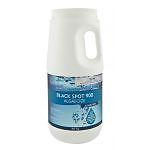
Long‑term algaecide, which includes Benzalkonium chloride (90 days of residual protection)
Filter cleaning to remove spores
Vacuum to waste to avoid recirculating algae.
For complete treatment details, you can find them at Black Spot Treatment full
Surviving roots deep in the surface
Spores hiding in filters, pipework, and solar heaters
Treatment was not maintained long enough
Poor circulation in shaded areas.
🏊 Is it safe to swim in a black spot pool?
Short answer: Swimming in a pool with visible black algae is not considered safe. Minor early spots may pose low direct toxicity, but once black algae is present, the indirect health risks and sanitation failures make the water unsafe.
Black algae are cyanobacteria, and some colonies can produce cyanotoxins, especially when the pool is poorly maintained or the infestation is established. These toxins can cause:
Gastrointestinal upset
Skin irritation
Other health effects if ingested
Black algae create a protected micro‑environment where E. coli and other pathogens can thrive. These bacteria—not the algae itself—are the primary cause of:
Ear infections
Eye infections
Gastrointestinal illness
Skin infections
If black algae is visible, chlorine has already been too low for too long. This means other pathogens may also be present.
Early, tiny spots may be low‑risk if chemistry is perfect, but once black algae spreads, cyanotoxin levels and bacterial load can rise.
Minor early spots might be low‑risk, but experts recommend stopping swimming as soon as black algae is noticed.
Established black algae = unsafe until fully treated.
Begin treatment: brushing, high chlorine, algaecide, and filter cleaning.
Resume swimming only when spots are gone, and chemistry is stable.
Today
Understanding Mustard Algae in Swimming Pools
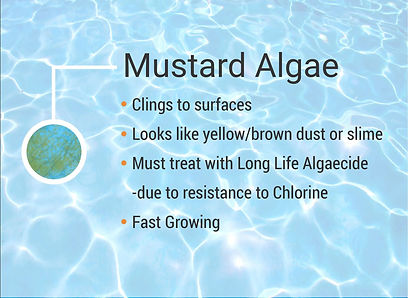
Mustard algae is a yellow‑brown, powdery, chlorine‑resistant algae that clings to pool walls, steps, and shaded areas. It is one of the most persistent pool algae and often returns unless the entire pool system — including equipment and accessories — is sanitised.
A form of yellow or yellow‑brown algae that resembles pollen, sand, or fine dust.
Appears in shady, low‑circulation areas: steps, corners, behind ladders, under lights.
Brushes off easily, forming a yellow cloud, but reappears quickly.
Often mistaken for dirt because it isn’t slimy and doesn’t float like green algae.
Mustard algae is notoriously stubborn because:
It has a protective biofilm that shields it from normal chlorine levels.
It can survive outside water for weeks or months on swimsuits, toys, brushes, and filters.
It resists chlorine up to 10 ppm, far higher than green algae.
It thrives in warm water, shaded areas, and low‑flow zones.
Use this quick test:
Brush the patch — if it forms a yellow cloud, it’s algae.
If it resettles in the same place, it’s likely mustard algae.
If it doesn’t cloud and swirl like sand, it’s debris.
Mustard algae itself are not highly dangerous, but it creates unsafe conditions:
Can harbour bacteria (e.g., E. coli).
Makes surfaces slippery.
Consumes chlorine, leaving the pool unsanitised.
Indicates poor circulation or low chlorine history.
Most outbreaks come from cross‑contamination, not spontaneous growth:
Swimsuits worn in lakes/rivers
Pool toys are stored damp
Brushes, nets, vacuum heads
Wind‑blown spores after storms
Low chlorine or poor circulation allows spores to bloom
1. Decontaminate everything. Wash swimsuits, towels, toys, brushes, vacuum hoses, and floats with chlorine solution. Mustard algae survive dry on the equipment.
2. Clean the filter thoroughly. Backwash sand/DE or soak cartridges — spores hide inside filters.
3. Brush all surfaces aggressively. Break the biofilm so chlorine can penetrate.
4. Balance water. Aim for:
pH: 7.8 (slightly higher for yellow‑algae treatments)
TA: 80–120 ppm
CYA: 30–50 ppm
5. Shock heavily. Raise free chlorine to 20–30 ppm (triple shock). Some treatments for heavy infestations require a yellow‑algae accelerator (a sodium bromide–based additive) before shocking.
6. Run pump 24–48 hours. Maintain high chlorine and circulation.
7. Brush daily for 72 hours. Prevents surviving spores from reattaching.
8. Clean the filter again. Removes dead algae and spores.
9. Vacuum to waste. Remove settled dead algae.
10. For complete treatment details, you can find them HERE
Maintain consistent chlorine (3–5 ppm).
Brush weekly, especially shaded areas.
Run pump 8–12 hours/day.
Wash swimsuits after natural water use.
Disinfect toys and equipment regularly.
Keep pH and alkalinity in recommended ranges.
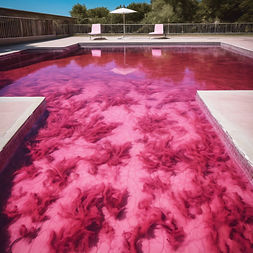
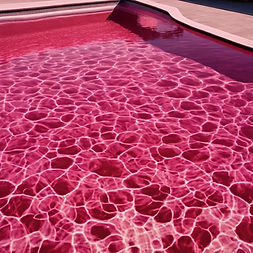
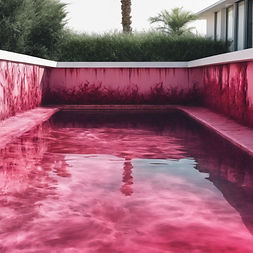
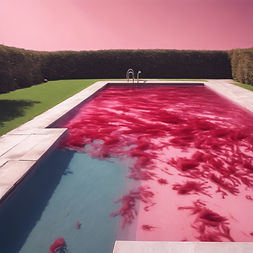
Colour — pink, red, salmon, or rusty‑rose patches.
Texture — slimy, jelly‑like, often forming a thin film.
Location — corners, behind ladders, around skimmer throats, inside light niches, and on vinyl liners.
Behaviour — brushes off easily but returns quickly if not fully eradicated.
Pink‑red “algae” (actually Serratia marcescens bacteria) can pose mild to moderate health risks to swimmers, especially when chlorine levels are low and biofilm is present. It is not usually dangerous in a properly treated pool, but it is not harmless.
The biofilm and bacterial load can cause rashes, itchiness, or dermatitis‑like irritation.
The biofilm and bacterial load can irritate the conjunctiva, causing redness or mild discomfort.
The biofilm and bacterial load of Serratia marcescens are opportunistic pathogens, meaning they can infect when conditions allow: Cuts and abrasions, folliculitis‑type reactions, urinary or respiratory infections in immunocompromised individuals.
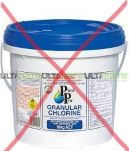
Avoid using this product to increase chlorine levels. If you are using a copper- based algaecide or if you are unsure of the pool history. This is to avoid staining on the pool surface.